 Chinese Knot Guide
Norigae vs Chinese Knot: Accessory, Knot, and Context
A pendant with a knot and a tassel is not automatically a Chinese knot, and norigae is not the Korean word for every decorative knot. The comparison becomes clearer once the whole accessory and the craft used in one part are named separately.
Quick Answer: For norigae vs Chinese knot, the key distinction is the level of identification. Norigae is a Korean decorative garment accessory that can combine an ornament, cord knots and tassels. Maedeup names Korean decorative knotting. Chinese knotting is a different craft category, with individual knots used in many objects. A shared tassel, red cord or similar outline does not make the names interchangeable or prove where an unidentified piece was made.
Three terms that should not be collapsed into one
- Norigae: correct category
- A Korean decorative pendant or garment accessory; the whole assembled object.
- Maedeup: correct category
- Korean decorative knotting and the knots formed through it.
- Chinese knotting: scope
- A cord-knot craft and its forms, not one standard complete pendant.
- Confusion to avoid
- Calling a whole norigae a Chinese knot because one component is knotted.
- Identification boundary
- Color, symmetry and tassel length alone do not establish provenance or a named knot.
The comparison is about terminology and documented use. It is not a national-origin test, a complete history of cultural exchange or a knot-construction tutorial.
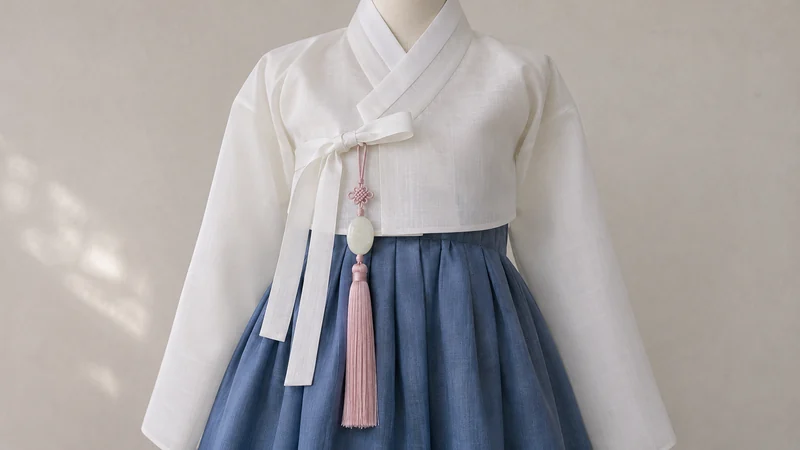
Norigae is the accessory, not merely its central knot
The Korea Heritage Agency's account of artisan Jeong Bong-seop describes knots used to adorn norigae suspended from hanbok. In its discussion of norigae, it treats the pendants as accessories with varied shapes, materials and uses. That wording does not reduce the whole accessory to a single knot.
Look at the assembly rather than just the most eye-catching loop: an ornament may be joined to cordwork and a hanging tassel, with fittings that connect the parts. The knot belongs in the description, but so do the ornament and the use of the complete piece. A loose knot on a work board does not, by itself, supply the whole garment accessory.
This matters for a label or a gift description. If the maker identifies the complete item as a norigae, preserve that term and its Korean clothing context. If only a cropped photograph is available, describe the visible pendant and tassel while leaving the precise identification open. Do not convert a resemblance into an authenticated object name.
Maedeup names the knot craft, not every object it adorns
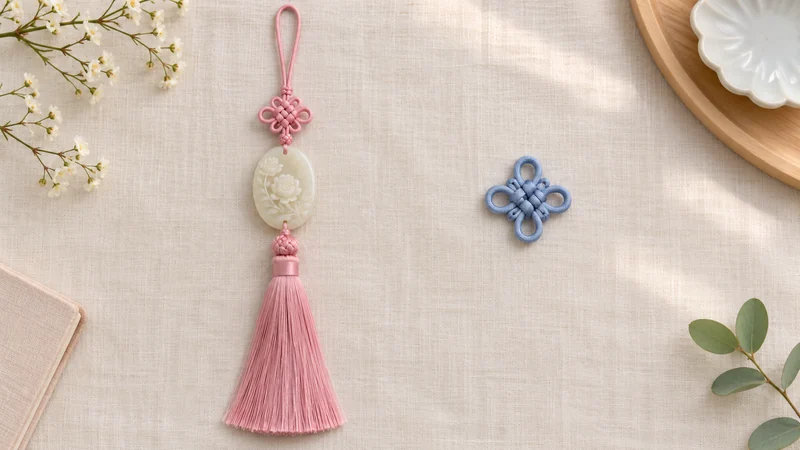
The same heritage account defines maedeup as decorative forms made by tying and braiding woven cords, or the resulting knots. It lists applications beyond norigae, including pouches, garment cords and interior decorations. Thus maedeup and norigae are related terms, but they do not have the same scope.
A useful way to read the relationship is 'a norigae incorporating decorative knotting', rather than 'norigae means one Korean knot'. The article describes several knot forms used in norigae; it does not prescribe one universal structure for every pendant. Nor does it say that a tassel is sufficient to identify a whole object.
If your task is learning a knot, ask for the specific name and a complete instruction sequence. If your task is describing a dress accessory, retain the accessory's name, materials and documented use. Confusing those tasks can leave a beginner with a pretty finished photograph but no usable directions for its crossings. This page deliberately supplies no tying sequence.
Chinese knotting is also broader than one hanging decoration
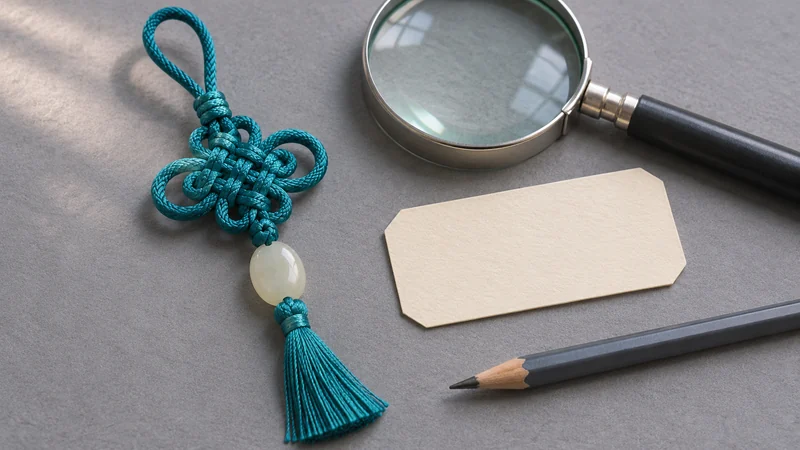
The Museum of Chinese Australian History's knotting programme describes a folk-art practice involving various knots and projects such as bracelets or charms. A Chinese knot can therefore be discussed as a craft form or as part of a finished object, not only as a large red hanging with two tassels.
That does not make every cord ornament Chinese. It explains why comparing a whole norigae with 'Chinese knot' can accidentally compare an accessory with a broad craft label. For a like-for-like question, compare documented complete objects, or compare two specifically named knot structures. Do not switch between those levels midway through the answer.
The site's Chinese-knot language guide explains the broad term 中国结 / 中國結 and why it does not identify a single pattern. Use it for that terminology question, not as a way to assign a country or exact structure to an unknown ornament. A specific knot name still needs suitable evidence.
Shared colors and tassels are not a provenance test
A red cord, symmetrical outline or long tassel is an observable feature, not a certificate of origin. The Korean heritage account describes varied colors and several uses of decorative knots. The Chinese museum's programme likewise discusses multiple knot forms. Those sources do not provide a rule that sorts every unlabelled object by its color or silhouette.
For example, an online listing might show only a cropped tassel and call the item an 'Asian lucky knot'. That wording leaves the maker, full construction and intended use unresolved. Ask for a full view and the supplied craft or object name. Do not decide that a pale pendant must be Korean, or that a red one must be Chinese.
Keep symbolism qualified too. A source may describe a wish expressed through an ornament; that is not evidence that wearing it produces fortune, protection or a relationship outcome. This comparison makes no claim about who invented all decorative knots or which national tradition owns every similar loop.
A useful label separates what is visible from what is known
Start with what can actually be observed: a complete pendant, its attached ornament, cordwork, tassel and fitting. Then add the documented maker's terminology or a collection record. Put uncertain material or provenance in an uncertainty note instead of quietly converting it into a fact.
For an unlabelled piece, 'knotted pendant with an attached ornament and tassel; precise identification unconfirmed' is more defensible than a national or historical attribution guessed from a photograph. For a documented norigae, use the supplied name and relevant clothing context. A modern decorative interpretation need not be presented as a surviving historical garment accessory.
The knot-book guide is useful if your next task is judging whether a construction source actually shows every crossing and tightening stage. It is not a catalogue that authenticates norigae or teaches every maedeup form. Choose the source for the task rather than letting a broad English label decide it.
Quick Reference: Norigae vs Chinese knot at the same level
| Term or question | Useful scope | Do not infer |
|---|---|---|
| Norigae | A documented Korean dress accessory or pendant | That its central knot names the entire object. |
| Maedeup | Korean decorative knot craft and its resulting knots | That every maedeup work is a norigae. |
| Chinese knotting | A craft with different forms and applications | That all knotted pendants belong to it. |
| Unlabelled ornament | Describe visible components; seek a maker or collection record | Provenance from red cord, tassels or symmetry. |
This is an identification framework, not an exhaustive typology or a claim that one visual detail establishes a national tradition.
Questions about accessory names and knot-craft labels
Is norigae simply the Korean name for a Chinese knot?
No. Norigae identifies a Korean decorative garment accessory, while a knot can be one component of the assembled pendant. The terms are not interchangeable.
Is maedeup the same thing as norigae?
No. Maedeup names Korean decorative knotting and its resulting knots. Those knots can adorn norigae and other objects.
Can a red tassel tell me whether a piece is Chinese or Korean?
No. Color and tassel shape alone do not establish provenance. Use a maker's description, a collection record or other object-specific evidence.
Does this page show how to tie a norigae knot?
No. It clarifies object and craft categories. The illustrations are not verified named-knot diagrams or a construction sequence.
Can the illustrations authenticate a historical accessory?
No. They are modern teaching scenes, not museum photographs, documentary records or evidence of a particular object's age or origin.
Institutional descriptions behind the distinction
- Korea Heritage Agency: Korean Decorative Knot Artisan Jeong Bong-seop, definitions and applications
- Museum of Chinese Australian History: Chinese Knotting programme and project scope
Sources read November 4, 2026. The heritage account supports Korean terminology and applications; the Chinese museum programme supports the craft's varied forms and projects. No museum photograph is reproduced, and the illustrations below do not document named historical objects.