 Chinese Knot Guide
Chinese Knot in Chinese: Characters, Pinyin, and Meaning
A practical lookup for readers who need the written term, a usable pronunciation, and a way to move from the broad craft name to the knot actually in front of them.
Quick Answer: “Chinese knot” is 中国结 in simplified Chinese and 中國結 in traditional Chinese. The Hanyu Pinyin is Zhōngguó jié. This phrase names Chinese knotting as a craft or category; it does not identify one exact pattern.
Chinese knot language facts
- Simplified Chinese
- 中国结
- Traditional Chinese
- 中國結
- Hanyu Pinyin
- Zhōngguó jié
- Plain-keyboard form
- Zhongguo jie
- Term type
- Broad craft and object category
- Identification boundary
- The phrase alone does not prove the specific knot pattern
Start with the three-character term, not a pattern name
The phrase has three characters: 中国结 or 中國結. The first two characters form the word for China. The final character is the knot character in this expression. Together, the phrase is commonly translated as “Chinese knot” or used for the broader practice of Chinese knotting.
That broad meaning matters when you label an ornament, search an archive, or describe a craft. A seller may use “Chinese knot” for an entire hanging decoration that combines a central knot, beads, cord loops, and a tassel. A museum record may use the same English phrase for the craft category. Neither usage tells you whether the central structure is a button knot, a double coin knot, a Pan Chang knot, or another form.
The Chinese knotting overview records the simplified form, traditional form, and Pinyin together. It is useful for confirming the basic language lookup, while a physical identification still requires a closer look at the cord path and finished shape.
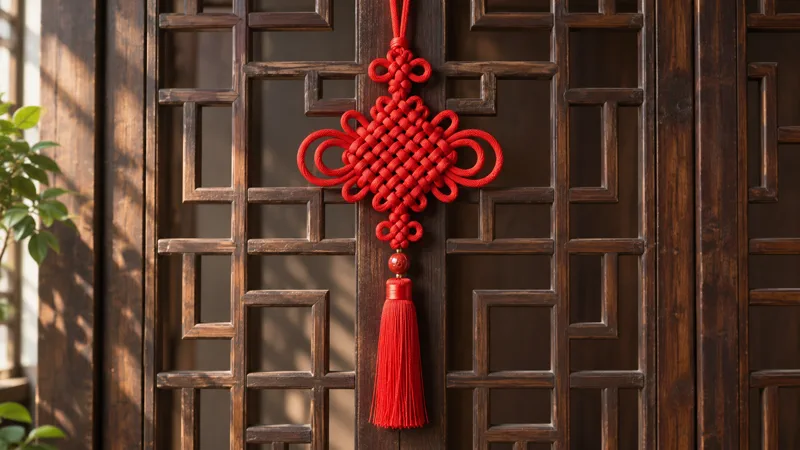
Simplified and traditional forms represent the same phrase
中国结 uses simplified characters. 中國結 uses traditional characters. The middle character changes from 国 to 國, and the last character changes from 结 to 結. The pronunciation and broad meaning remain the same.
Which form you see depends on the publication, community, collection record, keyboard, or market where the term appears. One script is not evidence that the object was made in a particular city, workshop, or historical period. Script choice belongs in the transcription field of a record; origin needs separate evidence.
If you are copying a label, preserve the characters exactly as they appear. Do not silently convert the script when the original wording matters. If you are creating a new English-language label for general readers, showing both forms once is usually clearer than switching between them throughout the page.
Pinyin records pronunciation, not a second Chinese spelling
Zhōngguó jié is the Hanyu Pinyin transcription. Pinyin uses the Latin alphabet to represent Mandarin pronunciation. It does not replace the Chinese characters, and it does not describe the knot’s structure.
The tone marks are part of the pronunciation guide: zhōng carries first tone, while guó and jié carry second tone. On a keyboard without tone marks, Zhongguo jie remains a useful search form, but the missing marks should not be mistaken for a different word.
The Library of Congress Chinese romanization table provides the formal Hanyu Pinyin framework used in cataloging. The University of Pittsburgh conversion guide is useful when older catalog records use a different romanization system. For this term, the characters remain the safest anchor across transcription styles.
A category name cannot identify the knot in your hand
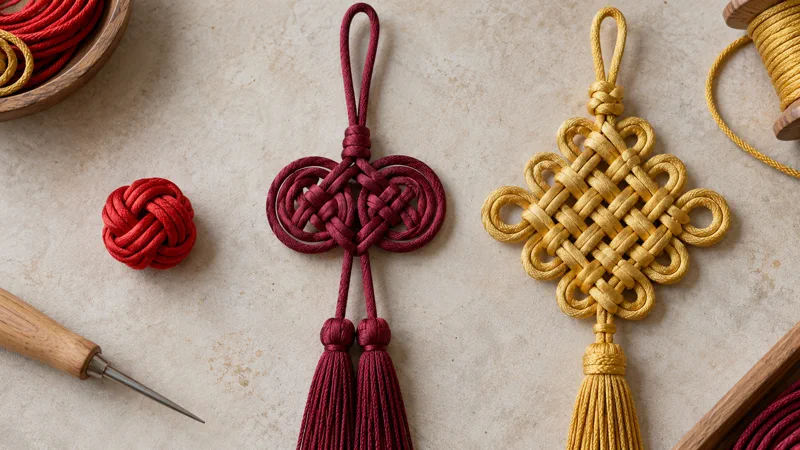
Three objects can all be called Chinese knots and still have visibly different structures. A compact spherical button knot is built for a different job from a paired-lobe double coin knot. A broad lattice-style Pan Chang knot has another cord path again. Calling all three Zhōngguó jié is not wrong at the category level, but it is incomplete when the pattern matters.
Start with observable features: Is the form flat or three-dimensional? Does it have one central body or paired lobes? Is the cord path open enough to follow? Is the piece a standalone ornament, a garment fastener, or one component in a longer hanging?
Then compare the structure with a focused guide. The double coin knot guide, button knot meaning guide, and Pan Chang knot guide answer different questions. This structure-first route is more reliable than assigning a name from color, tassel length, or a seller’s broad “Chinese knot” label.
Record the term without overclaiming
| Field | What to write | What it does not prove |
|---|---|---|
| Broad English term | Chinese knot or Chinese knotting | The exact pattern |
| Simplified Chinese | 中国结 | Maker or place of origin |
| Traditional Chinese | 中國結 | Age or historical period |
| Mandarin Pinyin | Zhōngguó jié | A regional spoken form |
| Specific knot name | Add only after checking the structure | Symbolism or promised outcome |
For a gift note, collection entry, or product description, separate what you can see from what you have verified. “Red Chinese knot ornament with tassel” is a defensible object description. “Antique prosperity knot from a named region” requires evidence for age, meaning, and origin.
Search for the exact form after you know its structure
A broad search for 中国结 returns many ornaments, tutorials, shops, and cultural introductions. Narrow the query by adding the object or construction you actually need. For example, pair the term with “button knot,” “double coin knot,” “bracelet,” “tassel,” or “tutorial.”
If you are trying to learn rather than identify, go directly to the Chinese knot tutorial hub. If you need a visual comparison, use the types of Chinese knots guide. If the question is cultural meaning rather than construction, the Chinese knot meaning guide keeps symbolism separate from pattern identification.
Image search can help you find candidate names, but it is not proof. Cropped photos hide crossings, commercial listings reuse broad names, and two tightened knots can look similar from one angle. Confirm the cord path against more than one view before you put a specific name into a permanent record.
Build a useful label from evidence you can inspect
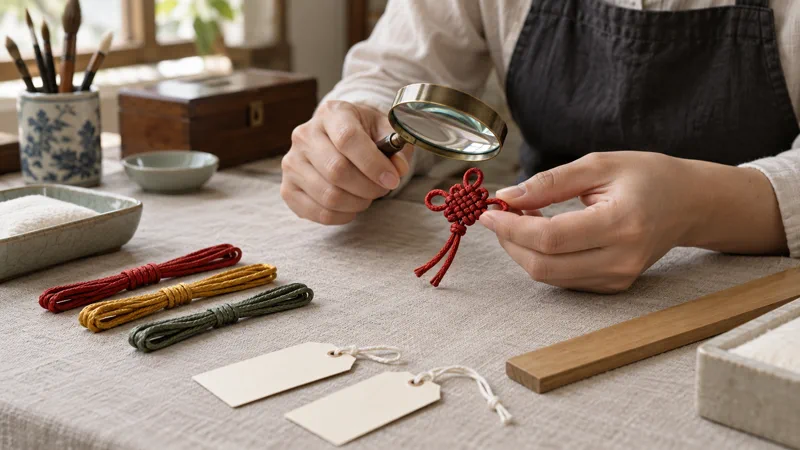
A good label begins with the physical object. Record the dominant structure, cord material if known, color, attached beads or tassels, dimensions, and intended use. Add simplified or traditional characters only when you know which term you are transcribing.
If the object came with a tag, photograph both the object and the tag before separating them. Keep seller language in quotation marks or in a source field rather than silently turning it into your own conclusion. A family description can be valuable evidence, but it should remain attributed to the person or record that supplied it.
For an unidentified knot, it is acceptable to stop at “Chinese decorative knot, exact pattern unverified.” That wording is more useful than a confident but unsupported name. The next researcher can then compare the cord path without first undoing a mistaken label.
What the language lookup cannot tell you
The phrase 中国结 does not by itself establish when an object was made, who tied it, where the cord came from, or why a particular family displayed it. It also does not guarantee luck, protection, wealth, marriage success, or any other outcome.
Symbolic interpretations belong to cultural context and documented use. A red hanging may be selected for a festival, a gift, visual balance, family preference, or several reasons at once. Describe the evidence you have, and keep belief or symbolism clearly qualified.
The same caution applies to translation. An English label may simplify several Chinese craft terms into “Chinese knot.” When precision matters, preserve the original characters, note the source of the wording, and distinguish the broad craft name from the specific knot type.
Language questions about Chinese knots
How do you write Chinese knot in Chinese?
Write 中国结 in simplified Chinese or 中國結 in traditional Chinese. Both forms name the same broad decorative-knot craft.
How do you pronounce 中国结?
In Hanyu Pinyin it is Zhōngguó jié. The tone marks show first tone on zhōng and second tone on both guó and jié.
Is 中国结 the name of one exact knot?
No. It is an umbrella term for Chinese knotting and Chinese decorative knots. A button knot, double coin knot, and Pan Chang knot have more specific names.
Are 中国结 and 中國結 different crafts?
No. They are simplified and traditional script forms of the same phrase. The knot in front of you still has to be identified by structure and context.
Can I search for a Chinese knot without tone marks?
Yes. Zhongguo jie is a practical plain-keyboard search, although Zhōngguó jié preserves the pronunciation more accurately. Adding a specific knot name or a clear photo usually narrows the result.
References used for the written term
- Chinese knotting overviewSimplified and traditional characters, Hanyu Pinyin, and broad craft context
- Library of Congress Chinese Romanization TableHanyu Pinyin conventions used in cataloging
- University of Pittsburgh Chinese romanization conversionContext for reading older and current romanized catalog forms
These sources support the written term and transcription. They do not authenticate a private object or establish its maker, age, origin, or symbolic purpose.