 Chinese Knot Guide
Choose a Chinese Knot Book: Edition, Diagrams, and Practice
Quick Answer: A useful Chinese knot book should do more than display finished ornaments. It should identify its edition clearly, show cord crossings in an order you can follow, explain how a loose layout becomes a tightened knot, and cover the projects you actually want to make. Before borrowing or buying one, test a single instruction sequence with real cord. That short test reveals more than page count, cover design, or a broad promise of “complete” coverage.
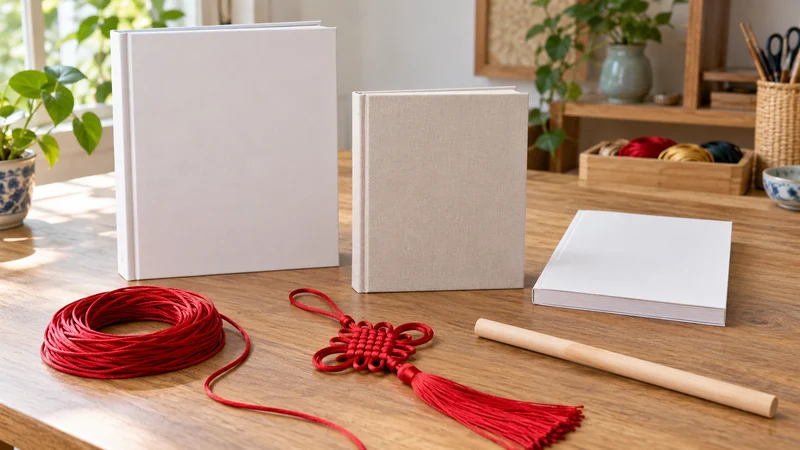
Book titles also need care. Library catalogs list several editions of Lydia Chen's Chinese Knotting, while The Complete Book of Chinese Knotting is cataloged separately. A title, author name, and cover photograph are not enough to prove that two listings describe the same edition.
Begin with the project you want to complete
Write down one near-term task: learn a simple two-cord structure, understand a named knot, add a tassel, or build a more complex decorative panel. Then check the table of contents and sample pages against that task. A broad historical survey can be valuable without being the best first instruction manual. A project booklet can be excellent for one ornament without explaining a wider knot system.
The goal changes the book test. If you want to follow the site's snake-knot tutorial, look for repeated left-right steps and tension photographs. If you are studying shape and symbolism, the double-coin knot profile gives you terms to compare with a book's index.
Quick facts to record before choosing a book
- Edition
- Record title, author, year, publisher, and ISBN together
- Diagram test
- One complete knot should show every crossing and tightening stage
- Coverage
- Match the table of contents to the knots you actually want to learn
- Workspace fit
- The book should remain open without covering the cord area
- Use boundary
- Library records identify editions; they do not prove instruction quality
- Edition: title, author, year, publisher, language, and ISBN
- Diagram test: one full knot should show every crossing and tightening stage
- Coverage: contents should match the knots or projects you plan to learn
- Workspace fit: the volume should remain open without covering the cord area
- Use boundary: library records identify editions; they do not prove teaching quality
These fields prevent two common errors: reviewing a different edition from the one available to the reader, and assuming a famous title automatically fits every learning style.
Identify the exact edition before comparing books
WorldCat records Chinese Knotting by Lydia Chen in multiple Chinese print editions. Open Library also lists several English editions across different years and publishers. WorldCat catalogs The Complete Book of Chinese Knotting: A Compendium of Techniques and Variations as a separate 2007 first Tuttle edition.
That does not mean one version is automatically better. It means a comparison must name the version. Record the ISBN when available, because a reused title can conceal changes in pagination, language, layout, cover, and distribution. If an online listing omits the publication year or ISBN, ask for the copyright page rather than guessing from the cover.
A library catalog is strong evidence for bibliographic identity. It is not a page-by-page review. Catalog metadata cannot tell you whether a diagram is readable at arm's length or whether a tightening instruction matches your cord.
Test whether one diagram sequence is complete
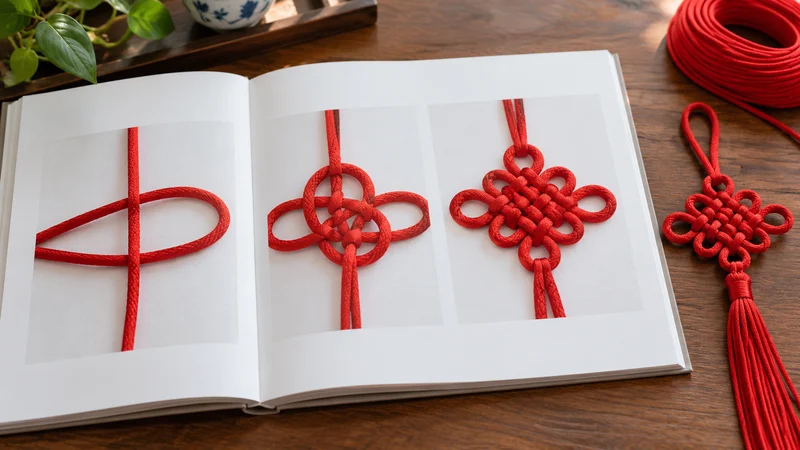
Choose one knot with visible crossings and follow the sequence from the first layout to the finished form. A usable sequence should answer four questions:
- Which cord end moves next?
- Does it pass over or under the crossing?
- Which loop or opening receives it?
- When and where is slack transferred during tightening?
Some books use photographs, some use line drawings, and some combine both. The medium matters less than continuity. If the page jumps from an open arrangement to a finished knot without showing how crossings are held and tightened, a beginner may reproduce the shape incorrectly even when every individual picture looks attractive.
Check orientation as well. The working end should remain visually identifiable from one stage to the next. If the book rotates the knot, the image or caption should make that change clear. Tiny arrows, crowded labels, or color pairs that become identical in grayscale can make an otherwise accurate sequence difficult to use.
Check knot coverage instead of counting pages
More pages do not guarantee better coverage for your purpose. A long book may devote substantial space to history, symbolism, gallery photographs, compound variations, or finished projects. A shorter volume may give a beginner more usable detail for a small group of basic knots.
Compare the contents with a personal list. Mark which basic structures are taught, which projects are shown from start to finish, whether compound forms identify their component knots, and whether finishing methods such as tassels or cord ends are explained. Look for troubleshooting: twisted cord, uneven ears, misplaced crossings, and distorted tightening are normal learning problems.
Do not treat a contents page as proof that every topic is explained deeply. Open the relevant chapter. A knot may appear only in a gallery, historical note, or variation list rather than as a full tutorial.
Choose a format that works beside real cord
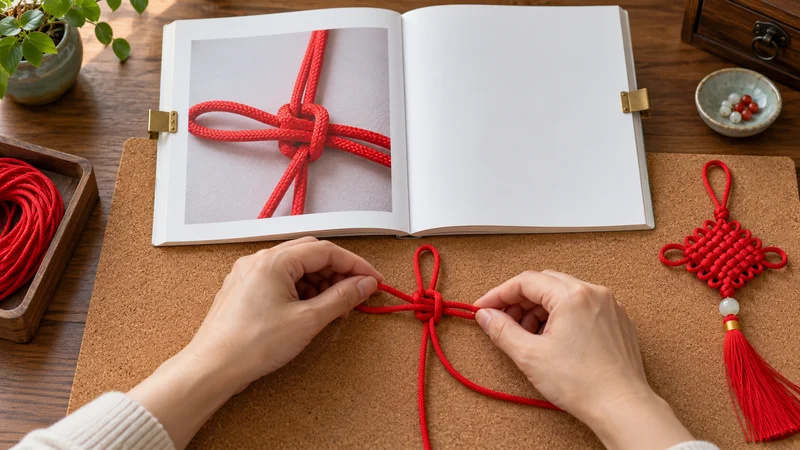
Chinese knotting often requires both hands, several open loops, and room to move slack. A book that closes itself or occupies the entire board can be awkward even when its images are excellent. Check whether it lies flat, can be held open without hiding the page, and presents diagrams large enough to see from your working position.
Digital and print formats have different tradeoffs. A digital page can zoom and may be easier to search, but a screen can dim, rotate, or sit too close to loose cord. A printed book stays visible without power, while a small binding may resist lying flat. Choose based on the actual workspace rather than assuming one format is universally superior.
Before beginning a project, gather the cord type and length specified by the chosen instruction. A book written around stiff cord or a particular diameter may not behave the same way with soft satin cord. Practice with inexpensive material before cutting a valued cord, and keep scissors closed and away from loose working strands when they are not in use.
Quick reference: a five-minute book test
- Record title, author, year, publisher, language, and ISBN.
- Find one knot you actually want to learn.
- Trace every over-under crossing without touching cord.
- Check that tightening is shown, not merely stated.
- Confirm the book can stay open beside your practice board.
If any step fails, the book may still be useful as history, inspiration, or an advanced source. It is simply not yet proven to be the right instruction book for this task.
Questions about choosing a Chinese knot book
What should a beginner look for in a Chinese knot book?
Look for large sequential images, clear over-under crossings, a visible tightening stage, basic knot coverage, and a format that stays open beside the cord.
Why does the edition of a knot book matter?
The same or similar title may appear in different years, languages, layouts, and publishers. Record the ISBN and publication details so a recommendation points to the edition actually reviewed.
How can I test whether the diagrams are clear?
Trace one complete sequence and identify which end moves, whether it goes over or under, where it passes, and how slack is tightened. Then test it with practice cord.
Do more pages mean a better Chinese knot book?
No. Page count may include history, galleries, variations, or projects. Match the actual contents and sample instruction pages to your learning goal.
Should I buy a book before choosing cord?
Check the materials section first. The instruction may assume a cord diameter or stiffness, so the book and practice material should be selected together.
The best Chinese knot book is the one whose exact edition you can identify and whose instructions you can reproduce safely with real cord. Catalog records establish which book you have; a hands-on diagram test establishes whether it works for you.