 Chinese Knot Guide
Can You Wash Chinese Knot Decorations? Care Checks
A red hanging ornament can look sturdy while its tassel, stitching or glued fitting needs gentler treatment. Before reaching for a bowl of water, work out what you are cleaning and whether the whole object has a documented care method.
Quick Answer: To decide how to clean Chinese knot decorations, check the complete ornament's material and care information, not just the cord. Do not assume it is washable because it is new, red or synthetic-looking. For an old, fragile or unidentified piece, avoid experimental wet cleaning and ask a textile conservator. A sound modern item with clear whole-item instructions should be treated according to those instructions, not a generic knot-washing recipe.
The details that change the cleaning decision
- Cord identification
- Supplier fibre information is more useful than a silky appearance.
- Attached components
- Check tassels, beads, metal fittings, stitching and any adhesive separately.
- Condition risk signals
- Loose fibres, detached parts and existing colour marks call for caution.
- Historic or sentimental value
- A replaceable decoration and a family heirloom need different risk decisions.
- Scope of this guide
- Pre-cleaning assessment, not a tested washing or stain-removal formula.
The museum sources below discuss textile collections, not tests of every Chinese knot product. Their cautions inform this decision process; they do not certify an ornament as washable.
Start with the label and the whole ornament
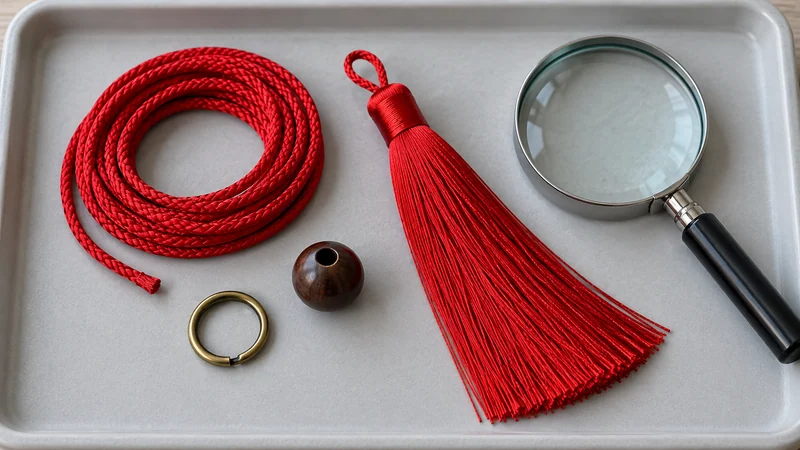
Lay the item where you can see its front, back and attachments without tugging on the knot. Look for the maker's care information or ask the seller to identify the cord and the complete assembly. A description of a loose spool does not necessarily cover the ornament made from it. If you have only a photograph of a similar product, treat its instructions as unconfirmed for your piece.
Check what the instruction actually permits. Does it describe the cord alone, or the finished hanging decoration with its bead, tassel and fastenings? If that distinction is unclear, ask before using water. Do not identify silk, rayon, nylon or polyester from sheen alone. The question is not which fibre seems toughest, but whether you have reliable instructions for this particular object.
Separate loose dust from stains and structural damage
Examine the surface in good light. Loose dust, a greasy mark, a frayed tassel and a detached bead are different problems. Photograph the present condition before deciding what to do. That gives you a useful description for a maker or conservator without rubbing a stain or pulling apart the knot to investigate.
Winterthur's textile conservation advice recommends monitoring dust and describes gentle removal methods, while treating wet cleaning of historic textiles as a significant intervention requiring tests. Those are different levels of treatment. A stubborn mark does not justify more brushing or a stronger cleaner.
Stop if your inspection loosens fibres or an attachment. Keep detached components with the ornament rather than reattaching them with an improvised glue. A photo can show where a part came from, but it is not evidence that the remaining cord is strong enough to carry it.
Do not let a sound cord overrule a fragile attachment
List each material you can identify: cord, tassel thread, bead, ring, hanging loop and any added decoration. Then note what remains unknown. You do not have to solve the chemistry of every component; an unresolved attachment is enough reason not to approve an improvised whole-item wash.
The Institute of Conservation's textile guidance explains that non-textile components can introduce their own deterioration problems, including staining from associated materials. It also advises specialist help when materials are uncertain. This is why a statement about washable cord cannot settle the care of a metal-trimmed ornament.
For example, suppose a modern hanging has a known cord but an unlabelled glued decoration. The useful next step is a question to its maker about the assembled item, not a guess at detergent strength. If the maker cannot resolve it, leave wet cleaning undecided. This is a decision example, not a report of a tested product.
What cautious surface care does and does not mean
First reduce unnecessary handling: clear a workspace and support the piece. Do not swing it by its hanging loop while inspecting a heavy lower fitting. The Textile Museum at George Washington University recommends supporting textiles on a tray or firm board when moving them, and warns that cleaning historic pieces without specialist advice can do more harm than leaving soil in place.
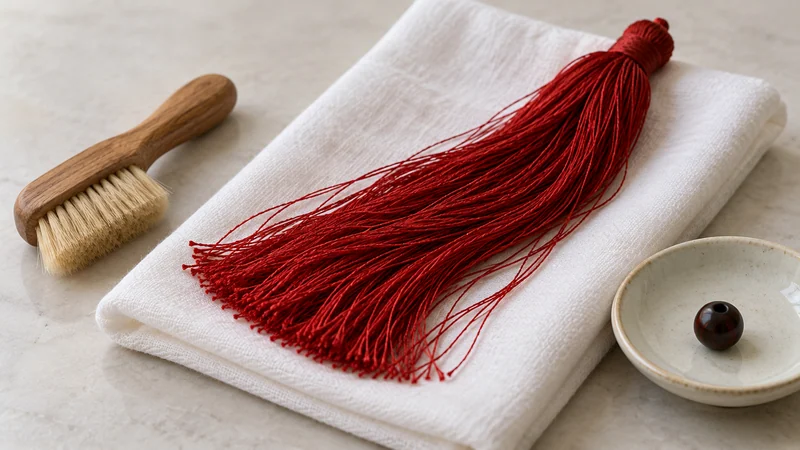
A soft brush sitting beside an ornament is not permission to scrub it. Winterthur describes careful dust removal with a soft brush or puffer and cautions against strong suction and abrasive brushing. For an intact everyday decoration, ask whether the maker recommends surface dust removal. For a loose, beaded or fragile piece, do not improvise a vacuum treatment based on a general textile illustration.
This page does not prescribe a brushing force, number of passes or chemical cleaner. No cleaning trial has been performed on the illustrative materials shown here. Stop rather than escalating treatment when the surface or construction responds badly.
When washing needs a different answer
For a sound contemporary piece, explicit instructions for the whole product are the starting point. Follow their limits rather than adding an unapproved soaking time, temperature or stain remover. If there are no instructions, this guide cannot turn uncertainty into a safe wash setting. Neither a bright colour nor a synthetic-looking cord establishes colourfastness.
For an heirloom, collect the questions instead of experimenting: what is known about the material, what damage is visible, what attachments are present, and what change do you hope cleaning will achieve? Ask a textile conservator to assess the options. Icon cautions against household detergents and bleach on historic textiles; a cleaner labelled gentle is not automatically suitable for them.
After inspection, avoid creating another care problem
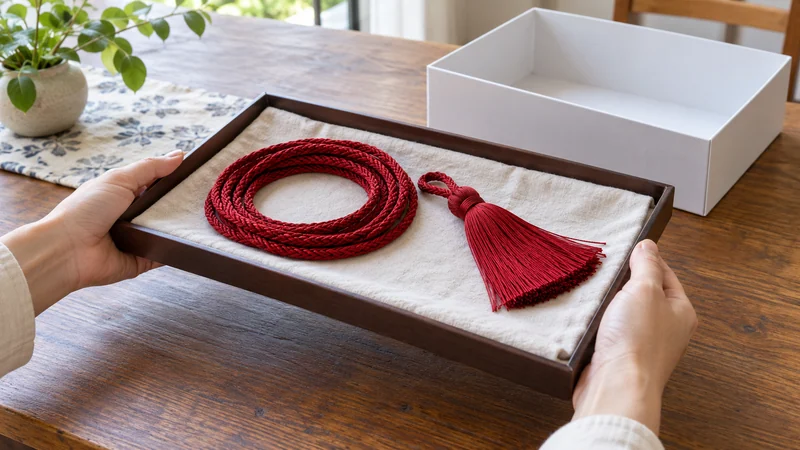
Choose a supported place for the ornament while you wait for advice. Keep its parts together and avoid compressing a tassel beneath a heavy fitting. Ask the person advising you how to support the actual shape; a box is useful only if the item can fit without being forced into it.
For longer-term care, the Textile Museum's guidance stresses environmental threats and careful handling. Winterthur also discusses protection from dust and light. These principles are not an argument for frequent washing: preventing repeated soiling and rough handling can be a more appropriate goal than making an old ornament look new.
The separate cord-project guide includes a storage section. If your real concern is a distorted knot rather than dirt, the tightening guide discusses slack management; it is not permission to manipulate a weakened historic piece. Choose the task that matches the problem instead of treating cleaning, repair and reshaping as one operation.
A decision before any cleaner touches the cord
| What you have | Next action |
|---|---|
| Intact modern item with whole-product care instructions | Follow the stated method and limits; do not substitute a general recipe. |
| Unknown fibre or unexplained coating or attachment | Ask the maker or a specialist; do not infer washability from appearance. |
| Loose threads, detached decoration or active damage | Stop handling unnecessarily and seek condition-specific advice. |
| Historic or treasured ornament with a stain | Ask a textile conservator before wet cleaning or stain removal. |
These are conservative decision branches, not proof that any pictured object is safe to wash.
Questions about cleaning a cord decoration
Can I wash a red Chinese knot in a washing machine?
Do not assume machine washing is suitable. Use instructions for the complete modern product if available; for an unknown, old or fragile ornament, seek advice rather than choosing a machine setting from this guide.
Does a nylon cord label mean the entire hanging is washable?
No. A cord label does not settle the care of attached beads, metal, tassels, dyes, finishes or adhesive. Ask whether the care advice applies to the assembled item.
Should I test a cleaner on a hidden part of an heirloom?
Not on the strength of this page. Testing a historic textile can itself be an intervention. Ask a textile conservator to assess the piece and appropriate testing.
Will dust removal restore faded red cord?
Dust removal and colour loss are different issues. Do not promise colour restoration or apply a stronger cleaner to chase a faded appearance; seek advice if the change is important or the fibres appear weak.
Textile care sources and their limits
- Winterthur Museum: textile conservation tips, especially Care and Cleaning
- Institute of Conservation: costume and textiles, materials and cleaning cautions
- The Textile Museum: handling and cleaning textiles
Sources checked November 2, 2026. These institutions discuss textile care, not product-specific washing tests of Chinese knot decorations. The scenes are illustrative and do not document cleaning trials or authenticated collection objects.