 Chinese Knot Guide
Tibetan Buddhist Lucky Knot Bracelet: Context Before Claims
Quick Answer: A Tibetan Buddhist lucky knot bracelet may be sold as a decorative cord bracelet, offered as a symbolic gift, or associated with a particular religious blessing. Those are not interchangeable descriptions. A red cord, a knot, or a Tibetan-style product name cannot by itself establish who made the item, whether it was blessed, or what a Buddhist teacher intended it to mean.
A blessing string has a religious context, not just a color
The Lama Yeshe Wisdom Archive publishes Lama Zopa Rinpoche's account of blessing strings. It describes cords blessed with recited mantras and explains their use within that teacher's religious practice. This is direct evidence for a documented blessing-string practice, not a description of every cord bracelet sold online.
The account makes spiritual claims about the strings. Those claims belong to the teaching and should be identified as religious beliefs, not presented as demonstrated effects of a material object. This guide does not promise that a bracelet prevents illness, changes an outcome, or provides physical protection.
If a teacher or Buddhist center gives you a cord, ask that community what it represents and how they recommend treating it. Their explanation is more useful than a generic shopping page's list of meanings. If you bought a bracelet as jewelry, it is equally reasonable to describe it as jewelry without adding an unverified blessing story.
Quick Facts
- Object description
- Cord bracelet or string; the provider must clarify religious context
- Primary religious source
- Lama Yeshe Wisdom Archive: a specific blessing-string account
- Motif source
- The Met: endless knot among Eight Auspicious Symbols on a quiver
- Provenance limit
- Color and a product name do not establish a blessing
- Practical boundary
- No promised protection or universal wrist rule
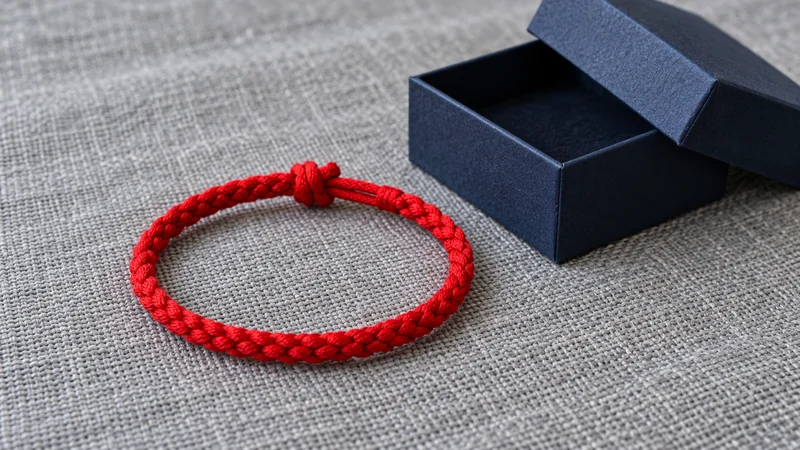
Three descriptions that a seller should not blur together
Quick Reference
| Description | What it tells you | What still needs clarification |
|---|---|---|
| Cord bracelet | The object is made to be worn around a wrist | Fiber, closure, maker, and fit |
| Bracelet with a Buddhist motif | A design is being identified with Buddhist imagery | Which motif, and the source for that identification |
| Blessed cord or blessing string | A religious act is being claimed | Who provided it, the practice involved, and the accompanying explanation |
These categories can overlap, but none automatically proves the others. A handmade bracelet need not be blessed. A blessing string need not have an elaborate ornamental knot. A symbolic gift does not have to be advertised as a ritual object to be meaningful to the giver and recipient.
Consider a hypothetical listing that says only "Tibetan lucky bracelet, red thread, adjustable." That gives you a style description and a closure claim. It does not identify a monastery, teacher, ceremony, or place of manufacture. Ask for those details only if they matter to your intended use; do not fill in the missing story from the photograph.
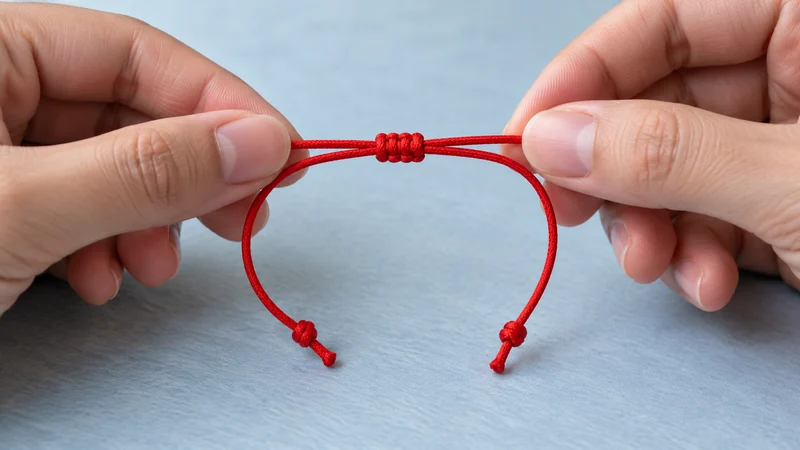
An endless-knot motif is not a certificate for a bracelet
The Metropolitan Museum of Art's record of a Tibetan or Mongolian quiver identifies the endless knot among the Eight Auspicious Symbols decorating that object. The record establishes a particular use of the motif in Buddhist art. It is not a bracelet record and cannot authenticate a modern seller's item.
A plain tie, a sliding closure, and a flat interwoven emblem do different jobs. The closure holds the bracelet on a wrist; a decorative emblem can carry an identified symbolic association. Do not call every small stopper knot an endless knot merely because the listing uses a Buddhist label.
Similar-looking cordwork does not make all uses, origins, or religious instructions identical. Keep the identification of an emblem separate from the physical task of holding a bracelet together. If a seller cannot identify the pictured motif, leave that part of the description unresolved.
Before wearing it: provenance, fit, and an honest gift note
For provenance, keep the explanation that actually came with the object: the maker or center's name, where it was obtained, and any specific instructions. A receipt can document a purchase, but it does not independently prove a blessing. A source that names a practice is more informative than a claim that the bracelet is simply "authentic."
For ordinary wear, inspect the actual closure and ends. An adjustable bracelet should open enough to pass over your hand without forcing it and should not tighten painfully when your wrist moves. Look for loose ends, damaged fibers, or hardware that catches. These are basic observations, not a durability test or a guarantee that a particular product is safe for every wearer.
No universal wrist rule is established by the two sources used here. If the cord was given in a religious setting, follow the giver's guidance. If it is ordinary jewelry, avoid inventing a spiritual left-hand or right-hand requirement. Remove or stop wearing it if it causes discomfort, and follow any relevant workplace or activity rules about jewelry.
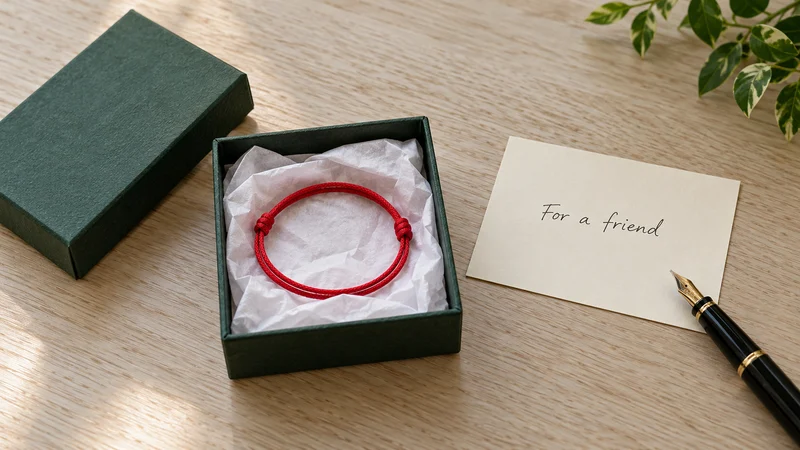
A modest gift note might say: "I chose this cord bracelet as a reminder of our friendship; I do not know it to be a blessed item." If it came from a named center with an explanation, pass that explanation on accurately. Neither note needs a promise of luck to express care.
For the separate craft question of size and material handling, the 5 mm cord guide explains why a nominal diameter is not a fit guarantee; it is about large decorative work, not a recommendation to use thick cord for this bracelet. The knot guide index provides navigation to other projects without establishing a religious connection between them.
Quick reference: what the label can actually establish
Quick Reference
| Label or observation | A careful conclusion |
|---|---|
| Red cord visible in a photo | A visible color, not proof of a universal Buddhist meaning |
| A sliding knot | A closure feature, not a blessing certificate |
| An identified endless-knot motif | A design to research in its own artistic or religious context |
| A named teacher's explanation | Evidence for that teacher's account, not every tradition |
| A seller's protection promise | A claim, not proof of a predictable real-world outcome |
You can appreciate the craft while leaving an uncertain religious claim unresolved. The useful distinction is between what the object visibly is, what its provider says about it, and what the available source actually supports.
Wearing and gifting questions
Is every red knot bracelet a Tibetan Buddhist blessing string?
No. Color and shape do not establish a religious origin or blessing. Look for a specific explanation from the person, teacher, or organization that supplied it.
Must a blessing string contain an endless knot?
The blessing-string account cited here does not establish that requirement. Do not confuse a functional tie or closure with a separately identified Buddhist emblem.
Which wrist should I wear it on?
These sources do not establish one universal wrist rule. Ask the provider for instructions if it was given in a religious context; do not treat an unsupported retail rule as a requirement shared by all Buddhists.
Does the bracelet guarantee protection or good luck?
No guarantee is established here. Religious teachings can attribute spiritual significance to a cord, but that should not be converted into a claim of proven physical protection or assured outcomes.