 Chinese Knot Guide
Chinese Crown Knot Step by Step: Four-Cord Path and Tightening
Chinese Crown Knot Step by Step: Four-Cord Path and Tightening. Teach one four-cord crown-knot variation with visible over-next loops, staged tightening, and tr
Quick Answer: For a basic four-cord crown knot, arrange four working ends in a cross, fold each end over the next to form four loops, pass the last end through the first loop, then tighten all four sides gradually. Keep the selected variation and cord orientation consistent throughout. Teach one four-cord crown-knot variation with visible over-next loops, staged tightening, and troubleshooting while distinguishing the method from a product label. This guide keeps source facts, worked observations, and cultural interpretation in separate layers so that the answer can be checked without turning symbolism into certainty.
Four-cord crown-knot construction facts
- Variation
- One basic four-cord crown-knot unit
- Setup
- Four working ends arranged at right angles
- Path
- Each end folds over the next; the fourth passes through the first loop
- Tightening
- Reduce slack in several balanced passes
- Safety
- Use blunt tools and follow material-specific end-finishing guidance
Choose the four-cord variation before cutting cord
## Quick Answer For a basic four-cord crown knot, arrange four working ends in a cross, fold each end over the next to form four loops, pass the last end through the first loop, then tighten all four sides gradually. Keep the selected variation and cord orientation consistent throughout. Teach one four-cord crown-knot variation with visible over-next loops, staged tightening, and troubleshooting while distinguishing the method from a product label. This guide keeps source facts, worked observations, and cultural interpretation in separate layers so that the answer can be checked without turning symbolism into certainty.
Begin with the recordable detail rather than a broad label. Different craft traditions use crown-knot names for related structures, so this guide fixes one repeatable unit. For chinese crown knot step by step, record variation as “One basic four-cord crown-knot unit” and keep it beside the source or observation that supports it. That wording matters because a search phrase can join several questions that need different evidence. State the method before drawing a conclusion, preserve any missing information, and avoid filling gaps with a personality claim, sales promise, diagnosis, or prediction. A useful explanation remains narrow enough that a reader can tell which part is documented and which part is an optional interpretation.
A second pass should test the limits of that description. Teach one four-cord crown-knot variation with visible over-next loops, staged tightening, and troubleshooting while distinguishing the method from a product label. In practice, compare the stated input with path: Each end folds over the next; the fourth passes through the first loop. If the page, package, record, or translation does not supply that detail, mark it unknown rather than converting an attractive image or familiar phrase into proof. Save the date and exact source used, because labels and web pages can change. The result should support a modest next action, such as checking a record, reading a complete passage, inspecting an object, or asking the maker. It should never substitute for medical, legal, financial, safety, mental-health, or other qualified professional advice.
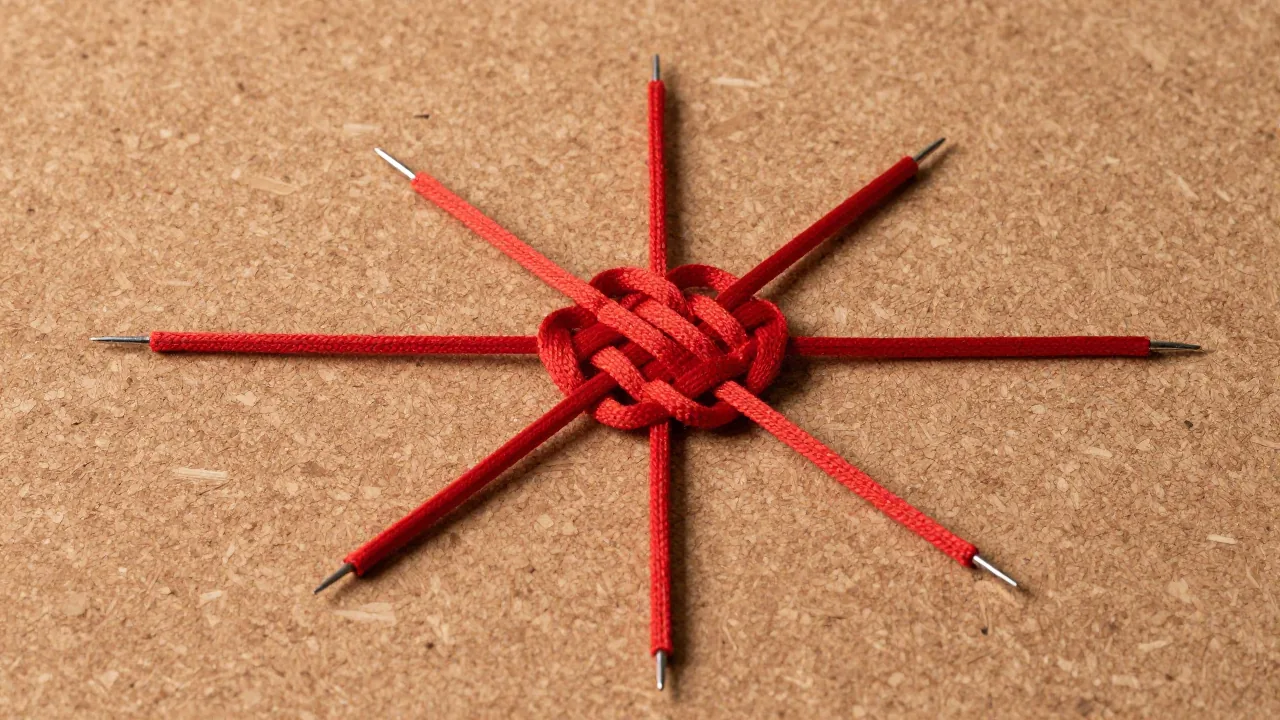
Lay out four ends and mark their directions
The first useful move is to separate description from interpretation. A flat work surface and distinct cord directions make the path easier to inspect. For chinese crown knot step by step, record setup as “Four working ends arranged at right angles” and keep it beside the source or observation that supports it. That wording matters because a search phrase can join several questions that need different evidence. State the method before drawing a conclusion, preserve any missing information, and avoid filling gaps with a personality claim, sales promise, diagnosis, or prediction. A useful explanation remains narrow enough that a reader can tell which part is documented and which part is an optional interpretation.
The next question is what the evidence does not establish. Teach one four-cord crown-knot variation with visible over-next loops, staged tightening, and troubleshooting while distinguishing the method from a product label. In practice, compare the stated input with tightening: Reduce slack in several balanced passes. If the page, package, record, or translation does not supply that detail, mark it unknown rather than converting an attractive image or familiar phrase into proof. Save the date and exact source used, because labels and web pages can change. The result should support a modest next action, such as checking a record, reading a complete passage, inspecting an object, or asking the maker. It should never substitute for medical, legal, financial, safety, mental-health, or other qualified professional advice.
Build the over-next loop sequence without tightening
A careful reader can make this section reproducible. Leaving generous open loops keeps every crossing visible before the structure closes. For chinese crown knot step by step, record path as “Each end folds over the next; the fourth passes through the first loop” and keep it beside the source or observation that supports it. That wording matters because a search phrase can join several questions that need different evidence. State the method before drawing a conclusion, preserve any missing information, and avoid filling gaps with a personality claim, sales promise, diagnosis, or prediction. A useful explanation remains narrow enough that a reader can tell which part is documented and which part is an optional interpretation.
For a worked note, keep method and conclusion in separate sentences. Teach one four-cord crown-knot variation with visible over-next loops, staged tightening, and troubleshooting while distinguishing the method from a product label. In practice, compare the stated input with safety: Use blunt tools and follow material-specific end-finishing guidance. If the page, package, record, or translation does not supply that detail, mark it unknown rather than converting an attractive image or familiar phrase into proof. Save the date and exact source used, because labels and web pages can change. The result should support a modest next action, such as checking a record, reading a complete passage, inspecting an object, or asking the maker. It should never substitute for medical, legal, financial, safety, mental-health, or other qualified professional advice.
Close the fourth pass through the first loop
This part of the question becomes clearer when inputs are kept visible. The final working end locks the sequence only when it follows the same over-next logic. For chinese crown knot step by step, record tightening as “Reduce slack in several balanced passes” and keep it beside the source or observation that supports it. That wording matters because a search phrase can join several questions that need different evidence. State the method before drawing a conclusion, preserve any missing information, and avoid filling gaps with a personality claim, sales promise, diagnosis, or prediction. A useful explanation remains narrow enough that a reader can tell which part is documented and which part is an optional interpretation.
When sources disagree, preserve the disagreement instead of averaging it. Teach one four-cord crown-knot variation with visible over-next loops, staged tightening, and troubleshooting while distinguishing the method from a product label. In practice, compare the stated input with variation: One basic four-cord crown-knot unit. If the page, package, record, or translation does not supply that detail, mark it unknown rather than converting an attractive image or familiar phrase into proof. Save the date and exact source used, because labels and web pages can change. The result should support a modest next action, such as checking a record, reading a complete passage, inspecting an object, or asking the maker. It should never substitute for medical, legal, financial, safety, mental-health, or other qualified professional advice.
Tighten in balanced rounds instead of pulling one end
The practical distinction is easy to miss in a short search result. Alternating small pulls distributes slack and reduces twisting or a pinched center. For chinese crown knot step by step, record safety as “Use blunt tools and follow material-specific end-finishing guidance” and keep it beside the source or observation that supports it. That wording matters because a search phrase can join several questions that need different evidence. State the method before drawing a conclusion, preserve any missing information, and avoid filling gaps with a personality claim, sales promise, diagnosis, or prediction. A useful explanation remains narrow enough that a reader can tell which part is documented and which part is an optional interpretation.
A reader should also record what would change the answer. Teach one four-cord crown-knot variation with visible over-next loops, staged tightening, and troubleshooting while distinguishing the method from a product label. In practice, compare the stated input with setup: Four working ends arranged at right angles. If the page, package, record, or translation does not supply that detail, mark it unknown rather than converting an attractive image or familiar phrase into proof. Save the date and exact source used, because labels and web pages can change. The result should support a modest next action, such as checking a record, reading a complete passage, inspecting an object, or asking the maker. It should never substitute for medical, legal, financial, safety, mental-health, or other qualified professional advice.
Diagnose crossed paths, uneven lobes, and loose centers
A bounded conclusion starts with what can actually be checked. If the unit tilts or one lobe collapses, reopen it and trace each crossing rather than forcing the cord. For chinese crown knot step by step, record variation as “One basic four-cord crown-knot unit” and keep it beside the source or observation that supports it. That wording matters because a search phrase can join several questions that need different evidence. State the method before drawing a conclusion, preserve any missing information, and avoid filling gaps with a personality claim, sales promise, diagnosis, or prediction. A useful explanation remains narrow enough that a reader can tell which part is documented and which part is an optional interpretation.
The final check is whether another person could repeat the same steps. Teach one four-cord crown-knot variation with visible over-next loops, staged tightening, and troubleshooting while distinguishing the method from a product label. In practice, compare the stated input with path: Each end folds over the next; the fourth passes through the first loop. If the page, package, record, or translation does not supply that detail, mark it unknown rather than converting an attractive image or familiar phrase into proof. Save the date and exact source used, because labels and web pages can change. The result should support a modest next action, such as checking a record, reading a complete passage, inspecting an object, or asking the maker. It should never substitute for medical, legal, financial, safety, mental-health, or other qualified professional advice.
Further Reading
- Chinese knotting cord guide - Chinese knot types
- Wikipedia knot overview - Chinese knotting overview
Trace and tighten the selected cord path
- **Variation:** One basic four-cord crown-knot unit
- **Setup:** Four working ends arranged at right angles
- **Path:** Each end folds over the next; the fourth passes through the first loop
- **Tightening:** Reduce slack in several balanced passes
- **Safety:** Use blunt tools and follow material-specific end-finishing guidance
Questions about making a crown knot
How should I handle variation for chinese crown knot step by step?
One basic four-cord crown-knot unit. Treat that field as one bounded part of the review, preserve its source, and do not extend it into an outcome claim.
How should I handle setup for chinese crown knot step by step?
Four working ends arranged at right angles. Treat that field as one bounded part of the review, preserve its source, and do not extend it into an outcome claim.
How should I handle path for chinese crown knot step by step?
Each end folds over the next; the fourth passes through the first loop. Treat that field as one bounded part of the review, preserve its source, and do not extend it into an outcome claim.
How should I handle tightening for chinese crown knot step by step?
Reduce slack in several balanced passes. Treat that field as one bounded part of the review, preserve its source, and do not extend it into an outcome claim.
How should I handle safety for chinese crown knot step by step?
Use blunt tools and follow material-specific end-finishing guidance. Treat that field as one bounded part of the review, preserve its source, and do not extend it into an outcome claim.