 Chinese Knot Guide
Chinese Button Knot Shirt Closures: Pankou Context and Fit
A practical guide to identifying a pankou closure, understanding the paired structure, and checking a shirt or jacket without assigning a universal meaning.
Quick Answer: A Chinese button-knot shirt usually closes with pankou, also called frog closures: a paired fastener with a knotted or toggle-like button on one edge and a receiving loop on the other. The visible knot is only half of the working closure; alignment, stitching, comfort, and garment fit determine whether the pair works.
Pankou shirt-closure facts
- Common English name
- Frog closure or frog fastener
- Chinese term
- Pankou (盘扣 / 盤扣)
- Working parts
- Button or knotted toggle plus a receiving loop
- Typical materials
- Fabric cord, braid, covered tubing, or shaped textile components
- Primary job
- Bring garment edges together and hold them closed
- Does not prove
- Age, region, handmade status, authenticity, or fixed symbolism
The closure is a pair, not only a knot
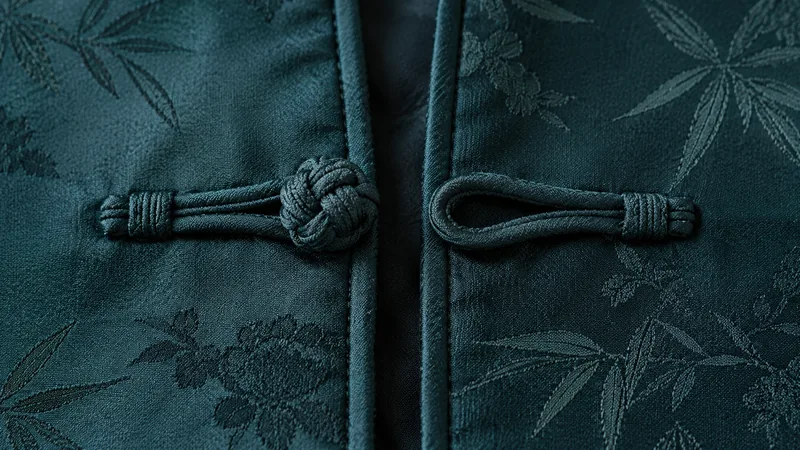
The English search phrase “Chinese button knot shirt” combines three different things: a garment, a knotted button, and the full fastener. The full fastener is commonly called a pankou or frog closure. One half carries the button or knot; the other carries the loop that receives it.
The pair can close two garment edges without the wide overlap used by many conventional buttons. On a shirt or jacket, the cord tails may continue into straight bars, compact coils, leaves, flowers, or other shaped arrangements. Those extensions can be decorative, but the working point is still the meeting of button and loop.
This parts-first definition prevents a common mistake: seeing any round cord knot and calling the entire piece a shirt closure. A standalone Chinese button knot may be used on jewelry, cord ends, or crafts. A working pankou must also include the receiving side and a secure attachment to the garment.
Why the knot and loop must be checked together
The button should enter the loop without being forced, yet it should not slip out during ordinary movement. If the loop is too tight, repeated fastening can pull on the stitching or distort the placket. If it is too loose, the shirt may open or sag even when the decorative work looks neat.
Alignment is just as important. Fasten the shirt and look at the center front or side opening from a short distance. The garment edges should meet cleanly, and the closure should not drag one edge upward. On a fitted qipao, strain around the bust, neck, or side opening can change how a closure sits; that is a garment-fit issue, not proof that the knot itself was tied incorrectly.
The stitching should anchor the cord without crushing it. Loose thread, twisting tails, exposed stiffening wire, or frayed braid are warning signs. A repair that only tightens the visible knot but ignores the loop and attachment points may not solve the real problem.
Plain closures and shaped pankou solve different design jobs
Some shirt closures are intentionally simple: a compact button, a small loop, and straight cord tails. This form keeps the fastening easy to read and lets the fabric or embroidery carry most of the visual attention.
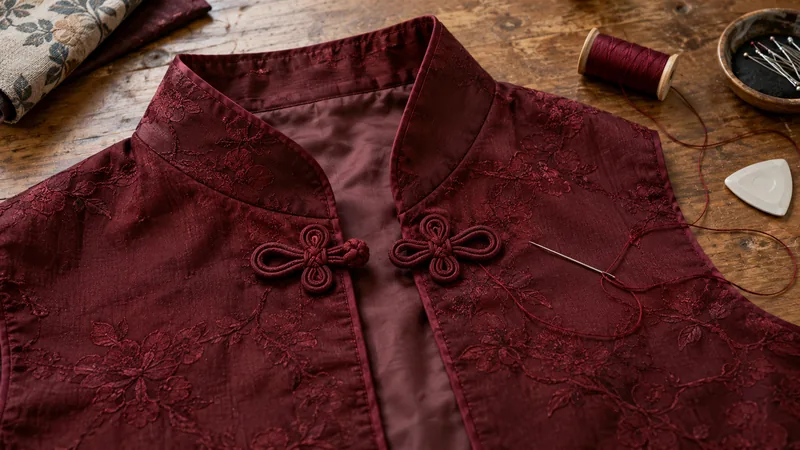
Shaped pankou use the cord tails as part of the design. They may form curved leaves, floral arrangements, or more elaborate symmetrical motifs. A 2022 feature on Putuo pankou describes silk or satin wrapped around a stiffening material for shaped work and notes that the craft can function as both fastening and ornament. That is a useful regional example, not a rule that every pankou uses the same material or comes from the same tradition.
For everyday wear, complexity is not automatically better. A raised flower near the neck may rub the skin. A wide decorative tail may curl after cleaning. A very stiff closure can overpower a lightweight shirt. The design should match the fabric weight, opening direction, and expected movement of the garment.
How to inspect a Chinese button-knot shirt
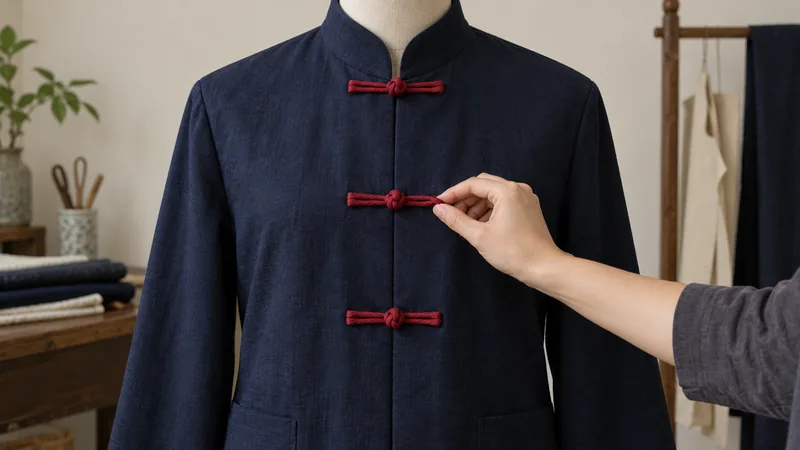
Start by fastening every closure rather than judging the shirt on a hanger. Then move your shoulders, sit, and turn gently. Watch whether the front stays aligned or whether one closure carries more tension than the others.
- Match every pair. Each button should line up with its own loop without pulling the fabric diagonally.
- Check entry and hold. The button should pass through with controlled pressure and remain seated during normal movement.
- Look behind the decoration. Confirm that attachment stitches are secure and do not expose sharp wire or rough ends.
- Check spacing. Multiple closures should share the load rather than leaving one tight point between wide gaps.
- Test comfort. Pay special attention at the neck, underarm, and side opening, where cord thickness can be felt against the body.
- Read the care label. The garment fabric, internal stiffening, and decorative cord may not respond to washing or pressing in the same way.
For a used or vintage garment, avoid treating replacement as a simple craft swap. New cord can differ in color, sheen, stiffness, and thickness. A tailor or textile conservator may be the better choice when the fabric is fragile, the original stitching matters, or a repair would require opening the garment layers.
Cultural context without a universal origin story
Pankou are strongly associated with garments such as the qipao and Chinese-style jackets, and regional makers continue to develop the craft. The Putuo example documents a local tradition in which shaped buttons have become both functional and ornamental. Museum and fashion-history records also show that frog fastenings appear in other clothing traditions and in varied materials.
That wider record is why careful wording matters. “Frog closure” describes a construction category; it does not automatically identify a garment as Chinese. Conversely, a pankou on a contemporary Chinese-style shirt should not be dismissed as merely decorative. Its function, shape, fabric, and placement can all be deliberate design decisions.
Symbolism also needs context. A floral or animal-shaped closure may carry a maker’s intended association, but the shape alone is not enough to promise luck, prosperity, marriage success, or protection. Ask what the seller, maker, family, or documented regional source says instead of assigning a universal meaning.
For readers who want to verify the vocabulary, the Fashion Institute of Technology’s frogging reference explains the broader closure category. The Putuo pankou feature gives a specific modern regional example. A London Museum object record shows why materials and forms should be checked object by object.
When to use a knot tutorial instead
Use this page when your main question concerns a shirt or jacket: what the fastener is called, how the pair works, and whether it is aligned and secure. If you need to tie the rounded knot itself, continue to the Chinese button knot profile and its dedicated tutorial path.
If your garment uses a different toggle, loop, or sliding construction, the broader Chinese knot closure guide is the better comparison. For repair planning, the Chinese knot cord guide helps you compare thickness, surface, and flexibility before choosing a replacement.
The useful next step is physical, not symbolic: fasten the garment, check how the two halves meet, and inspect the attachment points. Once the closure works correctly, its decorative form and cultural context are easier to appreciate without asking the knot to prove more than it can.
Questions about Chinese shirt knot buttons
What are Chinese knot buttons on shirts called?
They are commonly called pankou, frog closures, or frog fasteners. A complete closure has a button or knotted toggle on one side and a receiving loop on the other.
Is pankou the same as a Chinese button knot?
Not exactly. A Chinese button knot can form the button component, while pankou usually refers to the complete garment fastening and may include decorative cordwork around the pair.
Do all pankou designs have a lucky meaning?
No. Some shapes may carry documented local, family, or maker associations, while others are chosen for appearance or construction. The design alone does not guarantee a fixed meaning or outcome.
Can a damaged frog closure be replaced?
Often yes, but the replacement should match the original size, color, stiffness, spacing, and attachment method. Fragile or historically important garments need specialist advice before stitching is removed.
How should a pankou shirt sit when fastened?
The garment edges should meet cleanly without twisting, diagonal pulling, or one closure carrying all the tension. The button should pass through the loop securely without excessive force.